
American Artist Magazine · March 1976
Siegfried Hahn and Howard Wexler
Classical Principles and the Maroger Medium
By Mary Carroll Nelson
The instructors who shaped Carol Allison's artistic foundation — their classical methods, the Maroger medium, and the school in Albuquerque that changed everything.
"You wouldn't give a Stradivarius to the latest bumpity boom thumper; you'd give it to Heifitz. You wouldn't give the Maroger medium to an unschooled painter either; he would have no use for it."
— Siegfried Hahn
Hahn is the respected teacher of many zealous students in the unlikely city of Albuquerque, New Mexico. Far from the world's major museums, Hahn nonetheless bases his teaching on the masterpieces of art history in terms of technique as well as meaning. To do this he makes continuous use of reproductions for reference, both historical and contemporary.
An entering student, regardless of past experience, begins a structured sequence of classes. The first session is spent absorbing drawing precepts based on 19th century teachings of Horace Lecoq de Boisbaudran. This eminent Parisian instructor had among his pupils some of the most notable 19th century European painters, including Degas, Fantin Latour, Whistler, Renoir, Rodin, and Monet. His teaching spread via his students throughout Europe, to England, and to the United States. The Slade School in London was formed by his students.
Siegfried Hahn benefited from a partial exposure to Lecoq de Boisbaudran's classical training while a student at the Royal Academy in London. He is of the fourth generation removed from actual contact with the French master teacher — one generation later than Augustus John and Russell Flint. He says that with each succeeding generation of art students, less of the full body of Lecoq de Boisbaudran's teaching is passed on. Hahn's copy, in French, of Lecoq de Boisbaudran's The Training of Graphic Memory and the Forming of an Artist is well-thumbed, remembered, and honored.
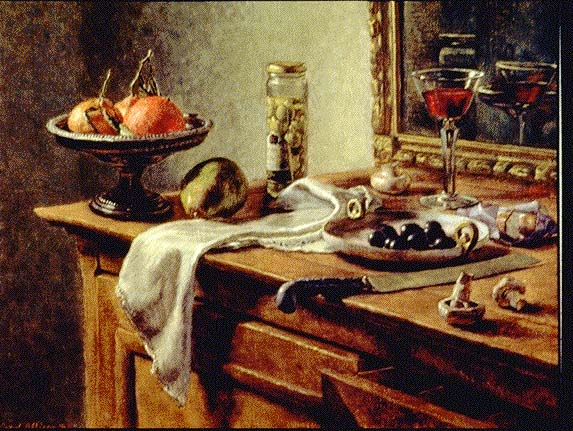
A still life demonstrating the Maroger medium
Drawing Principles of Lecoq de Boisbaudran
In The World of Rodin (Time-Life Library of Art) the method taught by Lecoq de Boisbaudran is described: "Combining precise study of a subject with freedom from rote in reproducing it, the method required a pupil to observe a plaster cast or an old engraving, for example, with the utmost diligence. But when the time came to draw such an object, he had to do so from memory, sometimes days after it had been removed from his sight." Hahn feels that developing the memory is essential to an artist and uses a modification of this exercise in his class, alongside working from models.
From Lecoq de Boisbaudran, Hahn adapted the following list of drawing maxims that he presents in his introductory talk to new students — and in all subsequent work insists on their observance:
Dimensions
Take any one part of the subject, which serves as a unit of measure to which a neighbor part(s) may be compared in size.
Positions
Imagine some horizontals and verticals passing through some main points of the subject, which show their relative positions in the composition, and onto these points all the rest of the subject hinges.
Forms
Compare the parts of the subject to the basic forms — cube, sphere, cylinder, cone, and pyramid.
Modeling
By means of light and shade the parts of the subject are made to advance and recede. The measure: between the lightest light and the deepest dark, the in-between intensities of light and shade are graded.
Color
Between the most brilliant and the drabbest of any color, its intermediate intensities are graded.
In Hahn's instruction the greatest emphasis is on developing a personal vision through practicing Lecoq de Boisbaudran's maxims. Hahn often quotes Degas: "Drawing is not the form — it is a way of looking at the form." He tells his students to distill the form, analyze it, but not to trace it mechanically. What is sought is the greatest eye-hand coordination.
Adding to the above list is another directive: Lines are to be analyzed into segments. Curves are to be seen and recorded in a series of segments rather than a single, unarticulated line.
The second lesson is devoted to the study of color. Students make two color wheels with compasses and transparent watercolors — one of hues and the depths of them in the pure colors, the other of various intensities of color. The lecture in this lesson is an explanation of the laws of contrasts and harmonies of color, stressing the influence one color has on an adjacent color.
The remaining eight three-hour sessions of the first term are spent drawing objects "sight size." This means rendering the subject as it is seen from varying distances within the studio — not according to the size we know an object to be, but as it is. From one or two objects the still-life groupings are gradually made more complex.
Drawings of these compositions are practiced on computer paper. The aim is exactness; shapes and spaces are analyzed, and perfected drawings are redrawn on watercolor paper. They are shadowed in transparent gray watercolor washes and then colored in appropriate washes of transparent watercolor, which results in three-dimensional, solid objects in space.
Hahn believes, "You must be an able artist with pencil and watercolor in order to handle the more elaborate medium of oil." He feels most students need a year or so working in pencil and watercolor before they attempt oils. By the third term, half of his students are trying oils for the first time.
The Maroger Medium
With the introduction of oils, Hahn also introduces the Maroger mediums: the Venetian, based on beeswax, and the Flemish, based on mastic, a resin from the Greek lentisk tree. With his longtime colleague Howard Wexler, Hahn prepares the mediums. Each year they have two cookings — one for the Venetian medium and another for the Flemish. They prepare about seven quarts of each and store it in 4-ounce baby food jars. Four ounces of the material is sufficient for at least a dozen paintings 16" × 20" — a good gauge of how little is required.
The Maroger medium, once it is ready, is more than just a commodity for Hahn and Wexler. It is a philosophy, a dedication, and a discipleship.
Siegfried Hahn
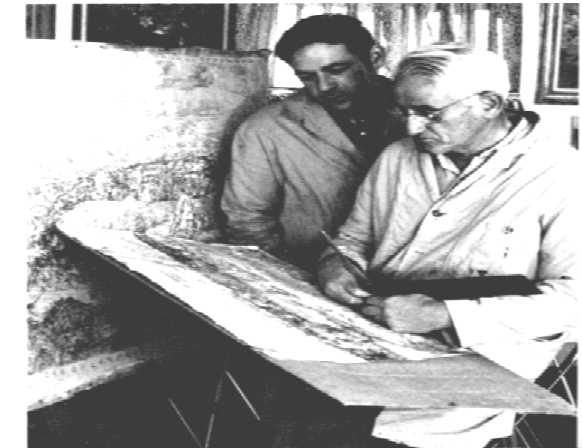
Hahn and Wexler reviewing a student's work
Tall, white-haired, with clear blue eyes, Siegfried Hahn was born in the Transvaal, South Africa. After four years of studying architecture, drawing, and painting in Johannesburg and Cape Town, he went to Europe to study drawing and painting from the live model at the Royal Academy under Sir Walter Russell, Sir William Russell Flint, Dame Laura Knight, and other eminent British artists of the time. He won a bronze, a silver, and the Turner gold medals and the study scholarships attached during his three years of study. Then followed two years at the École des Beaux-Arts, Atelier Sabatti, in Paris. World War II put an end to his studies.
After the war he traveled for eleven years throughout Europe, painting, exhibiting, and studying. (He is fluent in English, Spanish, French, German, and Dutch, and can speak Italian and Portuguese as well.) In 1957 he settled in Normandy to become a private instructor in art. Shortly he was discovered by the American Colony in Evreux, and for the next decade he trained numbers of American adults and children in a classical approach to drawing and painting.
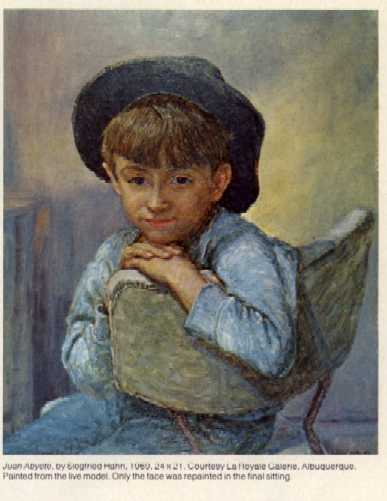
Juan Abeyte, by Siegfried Hahn, 1969, 24×21. Courtesy La Royale Galerie, Albuquerque. Painted from the live model. Only the face was repainted in the final sitting.
Howard Wexler
Howard Wexler, a native of Washington, D.C., studied at the Corcoran Art School and the Abbott Academy of Art, graduated from Pratt Institute in New York, served in the army in Europe, and was in Paris studying further at the Académie André Lhote and exhibiting his contemporary work. Wexler has worked with Hahn since 1961. His work has been exhibited widely in Europe and the USA. He is known for his floral still lifes and landscapes.

Sunflowers and Cosmos, Howard Wexler, 1974, oil, 24×18. Courtesy Griegos Gallery. Painted entirely alla prima.
The Maroger Correspondence
It was during twelve years in France that Siegfried Hahn wrote to Jacques Maroger and learned from him directly Maroger's theories regarding the mediums used by the Old Masters, how Maroger reconstituted these mediums, and how he recommended their contemporary use. Their warm, extensive, and mutually supportive correspondence continued until Maroger's death in June, 1962.
Throughout his protracted years of study, Siegfried Hahn had constantly sought to learn the methods of the Old Masters. The fresh, brilliant-looking translucent brushwork employed by the greats such as Vermeer, Rembrandt, and Rubens were not obtainable by any of the methods in use. Maroger felt he had successfully reconstituted a medium that corresponds in the essential principles to that of Rubens.
Of Rubens, Siegfried Hahn points out, "He was the sans pareil of all painters, able to extract, paradoxically, from the simplest means of the artist's palette, its widest range of expression." Maroger discovered that Rubens painted alla prima: directly, quickly, undertaken and completed in one session whenever possible.
In 1956 Maroger asked Joseph Sheppard, who had studied with him, to call on Siegfried Hahn in France. Sheppard taught Hahn how to cook the medium and how to use it, as Hahn says, "palette in hand." Hahn remembers Sheppard's help with appreciation and gratitude.
The Studio in Albuquerque
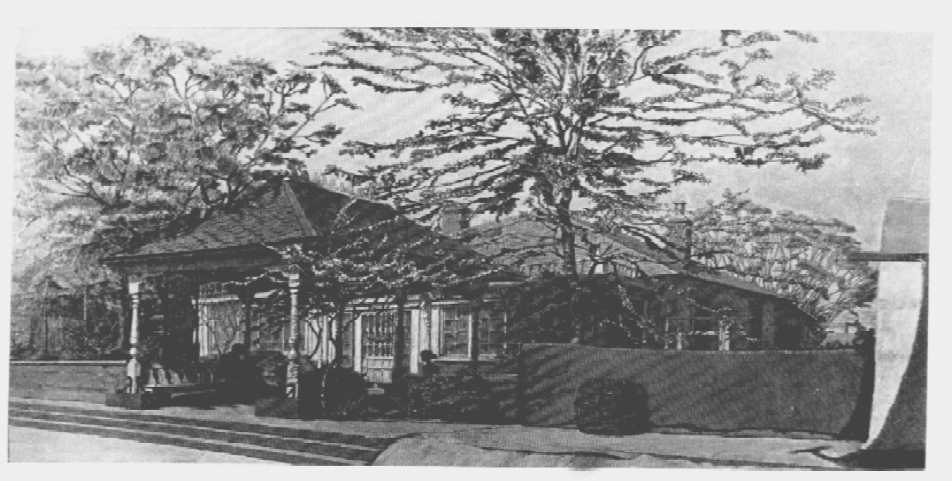
The Hahn-Wexler studio, Albuquerque, New Mexico
In 1968 Hahn and Wexler moved to New Mexico at the invitation of Colonel and Mrs. Russell Thomas. Their studio, a separate building not part of their home, is 40 by 25 feet. It roomily houses 18 students in a class — they teach seven sessions per week. The room is lit by north windows and a bank of ordinary, well-spaced, white lightbulbs. Sink, bookshelves, a hot water kettle noisily boiling on the hotplate, exact placement of chairs and easels, storage space, and large numbers of still-life setups of varying difficulty dot the room. The teachers wear long, gray lab coats. They are both remarkably courtly and articulate.
Points, large and small, are made by reference to a fine library of reproductions that both teachers seem to know by heart. "Ask questions," says Hahn. "There's no such thing as a stupid question." Answers are specific. No vague references are made. There are methods for doing the tasks assigned, and these are taught precisely. There is a formally informal atmosphere, a friendly ease couched in gentlemanly terms. All ages, walks of life — men, women, and children — come to learn; and learn they do.
The only thing not tolerated in the classes is half-heartedness. The assumption is made by the instructors and the students that what there is to learn is serious and involves a commitment. One of the students has remarked that "Art is a teachable science," as he has discovered in these classes. Another student comments that "the word discipline sums it all up."
The loyalty of the students for their teachers endures: some have studied for the full seven years the school has been available in Albuquerque. They are amazed to find these two polished, classic teacher-painters on the high mesa of New Mexico. Hahn explains their being in the Southwest: "The Southwest is known worldwide as a center for the arts and for painters such as those of the Taos School. From all the people we'd met who knew the Southwest, we'd never heard an adverse word. We were naturally drawn here."
Procedure for Using the Maroger Medium
The students by now can draw and suggest roundness by tonal control. "If your tonal (value) depths are right, color can be more arbitrary," is one of Hahn's reminders. For the first painting exercise the student paints a set of five small spheres using a very basic oil palette of umber, ochre, white, and black. Following the paint viscosity rule of applying "fat over lean," the student paints each stage in the complete build-up of creating a three-dimensional form.
The procedure is the same for the beeswax (Venetian) medium and the more brilliant mastic (Flemish) medium: Lay out the palette. Before beginning to paint, mix the medium evenly — by means of a palette knife — into all colors put on the palette, including the white. Use one-third or less medium per volume of each color. On a prepared painting surface spread a thin film of the medium over the area to be painted.
Stages of Maroger Oil Paint Application
Stage 1 — Transparent Shadow
Broadly indicate the shadow masses with a clean brush much as a wash drawing would be done. Use transparent colors (no opaques) with a little medium as the thinner. Absolute shadows are indicated with heaped touches of pure transparent color in warm earth or madder colors.
Stage 2 — Opaque Lights
Paint the light parts of the subject with a clean brush. Apply lights thickly. Place highlights on these areas. Pure white is not recommended alone for highlights, as it has no luminosity — slightly tinting it in accordance with the color of the source of light increases its luminosity.
Stage 3 — Reflected Light
Shadows contain reflected light: reflected lights should be thinly painted upon these fresh (still wet), shadowed, transparent first lay-ins. Use breathlike strokes, with a scant amount of white in the mixture. This mixture is opalescent, halfway between transparent and opaque.
Stage 4 — Demitint
The final tone is that of the demitint — an opaque gray made with black and white, leanly applied and of a value slightly deeper than the light zone it ends. It occurs in the areas where lights and shadows merge.
Stage 5 — Background
Once the foreground objects are completed, work on the background. To create distance the artist uses more opaque mixtures, often adding a little white to the colors used for backgrounds and distant shadows — giving the sensation of recession by aerial perspective.
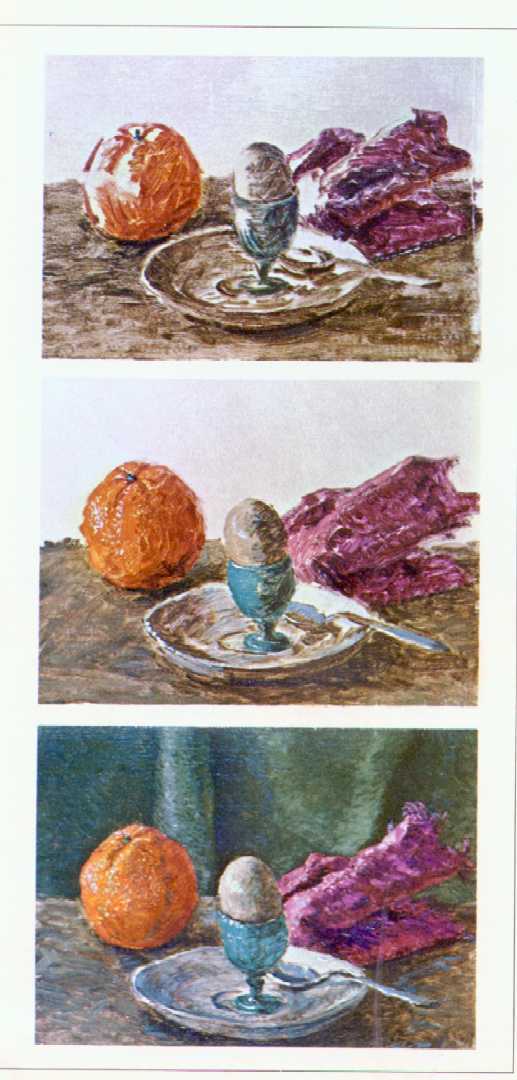
Three stages of the same still life — demonstrating the Maroger build-up from transparent shadows to finished lights
The ideal is the necessity of achieving a completed passage of painting in one session, wet in wet, attending systematically to all five tones. The appearance of the finished work when dried remains as it was when freshly painted.
The Students Speak
In a recent show of 54 paintings by students of Hahn and Wexler, the teaching methods proved themselves. The works in watercolor and oil — mostly still-lifes, several portraits, and only one landscape — had qualities in common: Space was clearly described and illuminated. Objects were three-dimensional, well-drawn and modeled in color, capturing texture as well as form. The oils had a brilliant-looking freshness. Harmony of color and scale relationships were apparent in each piece.
An articulate student made three observations about the training she was getting: (1) Students learn to draw as the "eye sees" in proportion. (2) Students learn tone relations, which is to a painting what a melody is to a song. (3) Students receive continuous guidance.
"Don't worry about your individuality. You can't disguise it anyway."
— Siegfried Hahn, quoting Degas
Hahn hopes that each accomplished artist will go on to use the Maroger medium in his own expressive way, but respectfully, as the regained tool of the Old Masters. He envisions a disciplined art, one which attempts to portray a three-dimensional form with classically trained ability. It is not a style he teaches, as much as a competence in the basic academic requirements of the professional artist.
Hahn asks, with unflagging dedication: "Of rewards without inconveniencing oneself, where's the logic?"
Copyright 1976 American Artist. Published March 1976, pages 44–69.
See the tradition in Carol's work
Carol studied under Hahn and Wexler for years. The classical principles described in this article are visible in every painting she created.