
American Artist Magazine · August 2004 · Online Exclusive
Modern Application of Lecoq de Boisbaudran's Drawing Method
by Carol Allison
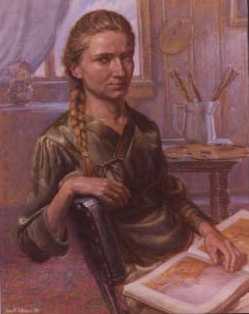
The author, Carol Allison
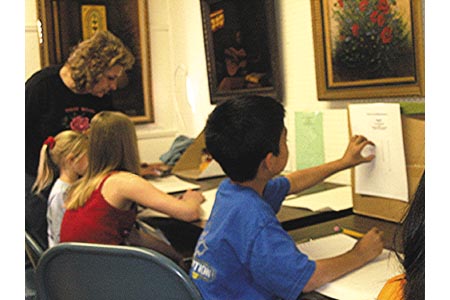
Carol teaching at the New Mexico Art League
I have taught adults and children for many years and have been using Lecoq de Boisbaudran's drawing methods since I first learned to draw. I became acquainted with his book while studying at the Siegfried Hahn/Howard Wexler School of Drawing and Painting, in Albuquerque, New Mexico. Hahn felt that Lecoq's teachings were the element missing from his studies at the Royal Academy of Arts, in London. After a friend of Hahn's found an English translation of Lecoq's teachings in a library, photocopies were made of the original, and I have used it ever since.
I am currently teaching children at the New Mexico Art League with painter Joan Irey. We follow the precepts of the Hahn/Wexler school and use Lecoq's methods. Irey keeps the Lecoq de Boisbaudran book in supply for students of our classes and for others who want it. Below is my summary of what I find most useful in creating my artwork and teaching, along with other pertinent information about Lecoq de Boisbaudran.
Lecoq de Boisbaudran's five basic principles, listed below, summarize what an artist does and considers when making a good drawing. They are taken from the 19th-century French professor's book The Training of the Memory in Art and the Education of the Artist and outlined by Siegfried Hahn. Most of the notable French and English painters of Lecoq's time studied with him or were influenced by the painters who did. These artists include Manet, Cassatt, Rodin, Monet, Degas, Whistler, Henri Fantin-Latour, Walter Sickert, James Tissot, Rosa Bonheur, Alphonse Legros, and many others. Whistler and Legros passed on this instruction at the Slade School of Fine Art, in London, where many well-known English artists in the late 19th century became proponents of these methods.
The following principles are the essential skills an artist needs to consider when they draw or paint. These principles will prove helpful as you confront problems in your work.
The Five Principles
Dimensions
Take any one part of the subject and use it as a unit of measure against neighboring parts.
Positions
Imagine horizontal and vertical lines passing through main points of the subject, showing their relative positions in the composition. The rest of the subject hinges on these points.
Forms
Compare the basic components of the subject to the basic forms in nature—cube, cone, cylinder, pyramid, and sphere. Observe the extent of exact conformity or the extent of modification of these forms in the subject.
Modeling
Parts of the subject advance and recede by means of light and shade. Determine the lightest light and the deepest dark; the in-between intensities are graded.
Color
The intermediate intensities of color are graded between the most brilliant and the drabbest hue.
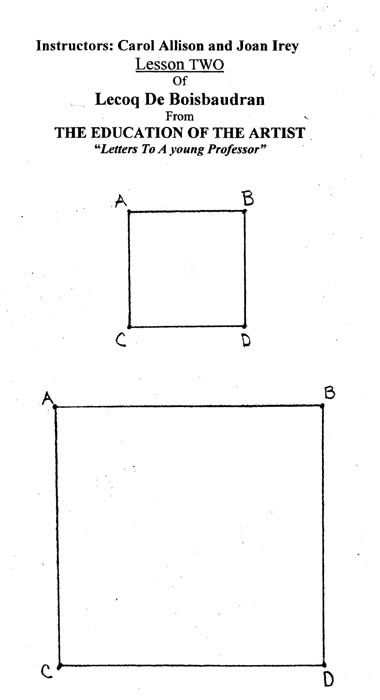
Lesson Two — Dimensions & Proportions handout
The Segmented Curve
A main characteristic of Lecoq's drawing approach is the emphasis on greater accuracy by breaking curves into segments. This allows greater control over the structure and a stronger drawing than curved lines would allow. It enables artists to find errors because they can pinpoint which line is off; with curves, it is hard to identify exactly where the drawing has gone wrong.
This characteristic of segmented curves can be seen in the work of the best drawers throughout the centuries, including Millet, Van Gogh, Degas, Cassatt, Augustus John, Cecilia Beaux, Whistler, Manet, Fantin-Latour, and others. Many of these artists were his students or used his methods. Rodin said he received the best training of his life when he attended Lecoq's school at age 17.
Lecoq's approach is very clear and succinct compared with other instruction on drawing. This professor goes right to the point of what an artist should concentrate on. His first exercises are excellent for preparing the basic skills needed for good drawing — and they help students avoid the less important aspects of the subject. These first exercises were passed on in letters he wrote to Alphonse Legros, who taught Lecoq's approach at the Slade School. The Slade School produced some very talented teenagers in the late 19th century using Lecoq's methods, including Wilson Steer, Augustus John, and Gwen John.
I have used these exercises extensively in my own teaching and can attest to how well they work in teaching people — including children — how to draw. After conscientious practice using his first lessons, students I have taught have noticeably improved their drawing skills and have become very adept at finding the lines in their subjects, tracing the line segments of curves, and looking more carefully at their subject.
I believe that learning to draw well using these principles is essential to developing the memory, and memory is a valuable asset that should be honed in conjunction with learning to draw.
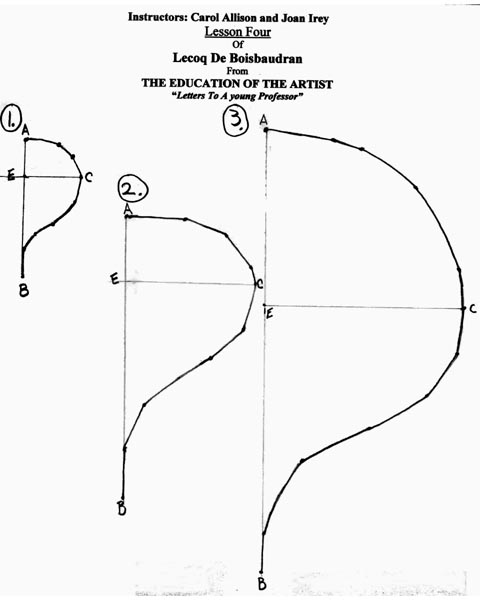
Lesson Four — Segmented Curves handout
Memory Drawing
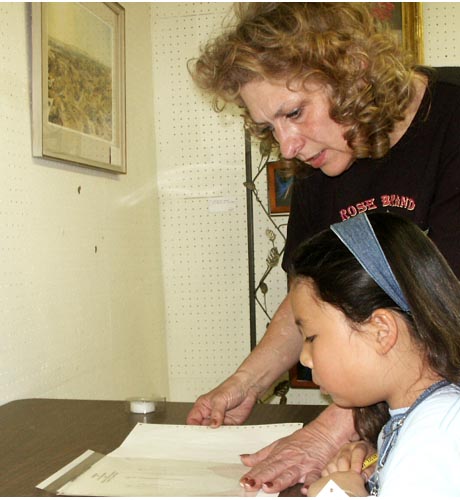
Co-instructor Joan Irey
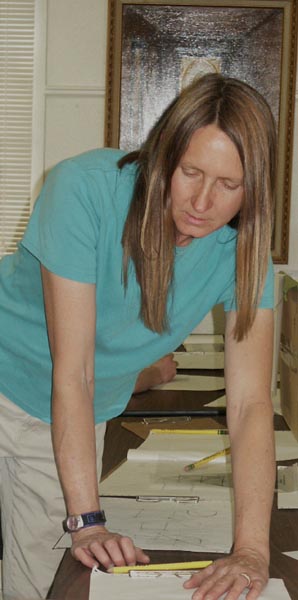
Carol reviewing a student's work
My colleague Joan Irey and I use memory-drawing exercises in conjunction with Lecoq's basic exercises, five principles, and main advice on learning to draw. After the children have drawn a subject to the point where they think they are finished, we have them turn their backs on the subject and draw it from memory. After these attempts at memory drawing, we tell them, as Lecoq advises, that if parts of the subject are hard to remember, then those are the areas they need to observe more carefully.
I find this basic memory exercise helps the students take a better look at their subject — they are more likely to focus on the bigger build of the subject rather than superfluous details. I often quote one of Hahn's teachers from the Royal Academy, Edna Clark Hall, who said, "If you have drawn your subject well, you should have no trouble drawing it from memory."
I have found that using the memory practice this way helps the artist distill and choose the most important lines from the lesser parts of the subject. Since drawing involves distilling the essential lines from the subject, memory practice helps the student focus on the few important lines and the main points to watch. The more succinct the drawing, the easier it is to remember. They go hand in hand.
Drawing is actually an act of memory. An important point Lecoq makes is that the artist in the action of drawing looks at the subject and retains it in memory before drawing it on paper. The time away from the subject simply can be lengthened. Beginner students in Lecoq's classes turned their backs on the subject or drew it an hour later. More advanced students went to the upper floors of the school to draw a subject after viewing it for shorter periods. The most advanced students were away from the subject as long as a week and viewed the subjects for only an hour or less before reproducing them from memory. Sometimes this was done in a museum — they viewed a painting and drew it again later.
A Six-Step Teaching Plan
Lecoq also emphasizes the importance of choosing the right subject matter and gradually increasing the difficulty as the student becomes ready for an increased challenge. We advance our students along a six-fold plan, preceded by study of Lecoq's five principles and his exercises:
Drawing pure basic forms — cubes, cones, cylinders, pyramids, and spheres.
White forms with planes or faceted forms where the boundaries, shape, and tones of the planes can be clearly seen.
Still lifes incorporating objects with obvious likenesses to the basic forms — books, cups, candle holders, eggs, jars, and pots.
Simple casts or forms relating to basic forms, progressing to classical replicas and anatomical casts.
Working from the live model — both figure drawing and portraits.
Landscape painting. The five principles are constantly reinforced at all levels of drawing and painting.
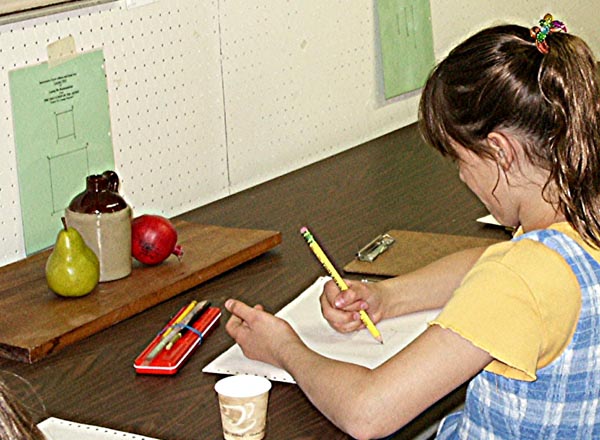
A student drawing a still life — step three of the plan
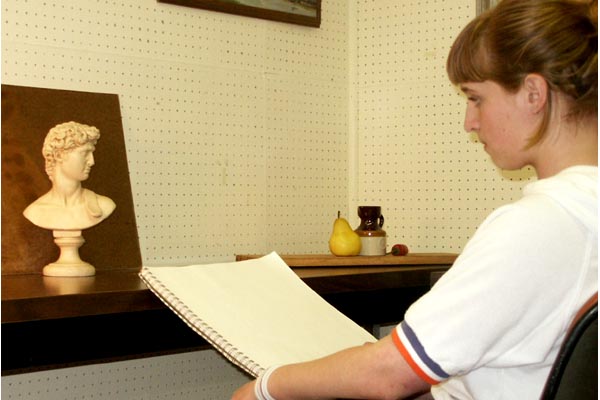
Studying a classical cast — step four of the plan
Watercolor, Color & Oil
After students gain proficiency in line drawing, we introduce Lecoq's principles in modeling and color via watercolor or pencil. The watercolor methods we teach are based on the English techniques of the Norwich School artists, including John Sell Cotman, Peter de Wint, Thomas Girtin, and J.M.W. Turner. Students apply neutral gray washes over the shadow and the areas of raking light in a careful pencil drawing. They also shade line drawings with pencil using the same principle.
After the shadows have dried, the students apply color washes, leaving white paper for highlights. We instruct them to consider and relate color as a tone depth first, then a hue. Next, we teach them how to make all of the most brilliant colors using a few primary pigments, painting a color wheel with a foundation of the gray washes mentioned above. Then, they make a second color wheel and scales to show how a mix of complementary colors can produce muted versions of the brightest colors in various degrees. This gives students a way to identify the many brown, beige, gray, and off-whites they encounter in nature, and it offers a starting point on how to mix them.
After the initial drawing tone and color exercises, the students are ready to apply their knowledge by depicting basic forms. After a level of proficiency is achieved in watercolor, the student can progress to oil using the mediums and approach researched by Jacques Maroger.
Copyright 2004 American Artist. Published online August 2004.
See Carol's work in practice
The principles she wrote about here are visible in every painting she created. Browse the full collection.