
The Artist
Carol Allison
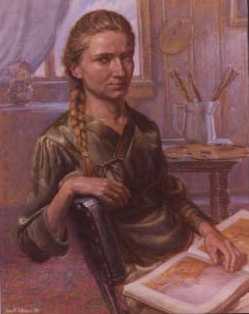
Carol Allison-Huntress
Rooted in the Old Masters tradition
Carol Allison's work is grounded in a rigorous classical education that spans decades. Trained in the techniques of the Dutch, Flemish, and Venetian Schools through the methods of Jacques Maroger — as well as the 18th Century English Watercolor tradition — her paintings reflect a deep respect for the craft and history of fine art.
Working primarily in oils and watercolor, Carol is drawn to landscapes, botanicals, still life, and portraiture — subjects that reward careful observation and reward the patient eye. Each painting is built with the same intention and technical discipline she has practiced since beginning her studies at age 15.
"The paintings were painted using Old Masters' techniques and painting mediums and 18th century English methods of transparent watercolor."

The studio
Background & Credentials
Artistic Education
An Albuquerque native, Allison came from an artistic family with relatives prominent in dance and theatre. She began her art training at the Siegfried Hahn–Howard Wexler School of Drawing and Painting at age 15, with studies focused on 18th Century English Watercolor and the oil painting techniques of Jacques Maroger and the Italian and Flemish Old Masters. Major emphasis was placed on the drawing principles of 19th century French Professor Lecoq De Boisbaudran. She also took sculpture classes at Harvard Continuing Education in Cambridge, MA.
Museum Studies
Frequent trips to study in the museums of New York City's Frick and Metropolitan Museums and the National Gallery in Washington DC. Others include the Museum of Fine Arts Boston and the Fogg Museum. International trips were taken to study paintings in museums in Brussels, Paris, Amsterdam, and London, including print room studies at the British Museum.
Publications
Carol Allison and her colleague Joan Irey were interviewed and published in American Artist 2004 Drawing issue for the article "The Tradition of Drawing From Memory." She also authored an exclusive online article at American Artist's website describing classical drawing and painting techniques used in her classes.
Teaching Experience
Taught classical painting to children at NM Art League with artist Joan Irey. From 1978 onward she conducted classes at her studio Pinacotheque Art Academy, Art Masters Academy, New Mexico Art League, Albuquerque Technical Vocational Institute, and workshops in Morocco at DAR America.
Artistic Group Activities
From 1978–1984 she co-owned and operated Pinacotheque Art Academy & Gallery with artist Dan Griggs, teaching drawing and painting and demonstrating classical techniques to the public. She helped organize the first exhibitions of Jacques Maroger in the Southwest, facilitated the purchase of an original Maroger painting for the Albuquerque Museum, and has appeared in numerous shows in New Mexico and the Southwest featuring Maroger and other artists using the Maroger medium.
Carol's Recipe
The Maroger Medium
Passed down through Siegfried Hahn from Jacques Maroger himself, this is the recipe Carol used throughout her painting career — the same medium employed by Rubens, Rembrandt, and the Old Masters. Carol added her own notes from years of experience preparing it.
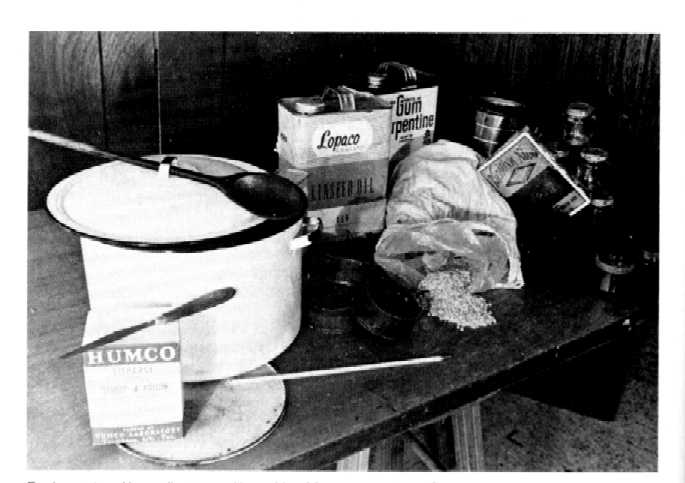
The supplies for cooking the Maroger medium — enameled pot, linseed oil, gum turpentine, mastic crystals, and tools
Precautions
- Allow no water or other cold liquid anywhere near the cooking process. All materials must be absolutely dry. A drop of water in hot oil could cause violent splattering.
- Use an asbestos mat on the flame to avoid direct heat on the pot.
- Use a pot nearly twice as large as required — the mixture will expand while cooking.
- Litharge (lead oxide, PbO) is poisonous. Handle with care.
Hahn advises: "We are aware of valid variations on these recipes that work well in competent and responsible painters' hands. For example: more or less litharge (the most being 1/10 the weight of the oil; the least being 1/20 the weight). In New Mexico's dry atmosphere we use the minimum litharge quantity recommended by Maroger. Longer cooking at a slightly lower temperature is acceptable."
Recipe: Venetian Medium
Makes seven quarts (can be halved)
Ingredients
- —7 quarts raw linseed oil
- —10 oz litharge (lead oxide, PbO) — poisonous
- —24 oz pure, untreated beeswax
Equipment
- ·Enameled pot with lid
- ·Thermometer reading to 300°C
- ·Wooden spoon, asbestos mat, ladle
- ·Clean 4 oz baby food jars with screw lids
- ·Painting spatula, sheet of glass
- ·Several sheets of newspaper
- ·Gas stove (flame easily controlled)
Mixing
Put enameled pot and sheet of glass near each other on table. Empty beeswax into pot. Pour off up to ½ cup of the oil and set aside. Pour the rest of the oil into the pot onto the beeswax. On the glass sheet, use a spatula to mix the saved oil and litharge into a loose paste in small batches for even consistency. Add all to the pot.
Cooking
Place asbestos mat over burner. Cook on medium heat for a total of 2½ hours, stirring occasionally. After 1 hour: reach 160–180°C — no higher. After 2 hours: just over 200°C. Final half-hour: raise to 250°C over very hot flame. Stop at exactly 250°C. Do not exceed 250°C — prolonged cooking creates a chewing-gum consistency unsuitable for painting.
Storing
Place newspaper padding on table in a cool location. Allow temperature to drop to 140°C, then ladle into jars, filling ¾ full. Allow to cool and solidify. Add water to fill jar and lid tightly to keep airtight.
Carol's note: "If using tubes, the mixture needs to cool further so that the tops of the tubes don't melt." (Water is only needed for jars.)
Recipe: Flemish Medium
Makes seven quarts (can be halved)
Ingredients
- —4 quarts raw linseed oil
- —6 oz litharge (lead oxide, PbO) — poisonous
- —3 quarts turpentine
- —42.8 oz mastic crystal tears (resin from the lentisk tree — dry, translucent, yellow-white crystals)
Procedure
For this medium, only the litharge and oil are cooked. Mix the litharge with up to ½ cup of the oil in small batches on the glass sheet to make a smooth paste. Add to the rest of the oil and begin cooking. This medium requires lower heat than the Venetian as it cooks faster — follow the same times and temperatures as the Venetian recipe.
Preparation
At the end of 2½ hours at 250°C, remove from heat and allow to cool only to 200°C. Stir and fan to hasten cooling. Add mastic crystals in small amounts, stirring constantly — the mixture will expand and foam, but will descend with stirring. When all mastic is incorporated, add turpentine very slowly and cautiously. Adding too quickly can cause an eruption. Allow to cool to 130°C and ladle into jars, filling ¾ full.
Carol's note: "At this point I recommend straining the mixture through cheesecloth or a paint strainer, as bits of bark, twigs, and dirt are in the mastic. It worked well to have another pot the same size on hand so the whole mixture could be strained at once."
"If using tubes, the mixture needs to cool further so the tops don't melt — leave about 1¼ inches from the top to close the tube."
Storing
Allow to cool and solidify. Add water to fill jar and lid tightly. Beneath its layer of water the medium should keep indefinitely. Add water during use to keep it covered.
Recipe source: American Artist, March 1976, p. 42. Prepared by Siegfried Hahn and Howard Wexler. Personal notes by Carol Allison.
Exhibition History
Galleries & Additional Exhibitions
1987–2005
- •Kavanaugh Art Gallery, Des Moines, IA
1984–1998
- •Weems Gallery, Albuquerque, NM
1987–1990
- •Weems Artfest, Professional Juried Show, Albuquerque, NM
1992
- •Art Masters Academy, Faculty Exhibition, Albuquerque, NM
- •Magnifico, Juried Exhibition, Albuquerque, NM
1991
- •New Mexico State Fair Gallery, Professional Artist Juried Exhibition, Albuquerque, NM
1990
- •Fein and Klein Gallery, Maui, HI
- •New Mexico State Fair Gallery, Professional Artist Juried Exhibition, First Place (Watercolor), Albuquerque, NM
1989
- •Art Masters, Student–Faculty Exhibition, Albuquerque, NM
- •Wailuku Gallery, Maui, HI
1988
- •Realist Gallery, Featured Artist, Santa Fe, NM
1987
- •Laguna Gloria Art Museum, National Juried Professional Exhibition, Austin, TX
1986–1987
- •Albuquerque Artists Association, Juried Fall Exhibition, Albuquerque, NM
- •Four Hills Country Club, Invitational Artists' Show, Albuquerque, NM
1986
- •Albuquerque Retrospect 1986, NM Arts & Crafts Fair 25th Anniversary Invitational Exhibition, Albuquerque, NM
1985–1997
- •New Mexico State Fair Gallery, Professional Artist Juried Exhibition
- — 1988: Second Place (Oil Painting)
- — 1987: Second Place (Oil Painting)
1978
- •Pinacotheque Faculty Exhibition, Pinacotheque Art Academy (co‑owned by Carol Allison)
1977–1978
- •New Mexico Arts & Crafts Fair, Juried Exhibition, Albuquerque, NM
1975
- •Southwest Art Gallery & Music Studio, Siegfried Hahn & Howard Wexler Student–Faculty Exhibition
1974
- •Siegfried Hahn–Howard Wexler School of Drawing and Painting, Annual Exhibition, Statesman Club
Explore the collection
Carol's paintings are preserved here as a lasting tribute to her artistry. Browse the full gallery to experience the beauty she spent a lifetime creating.